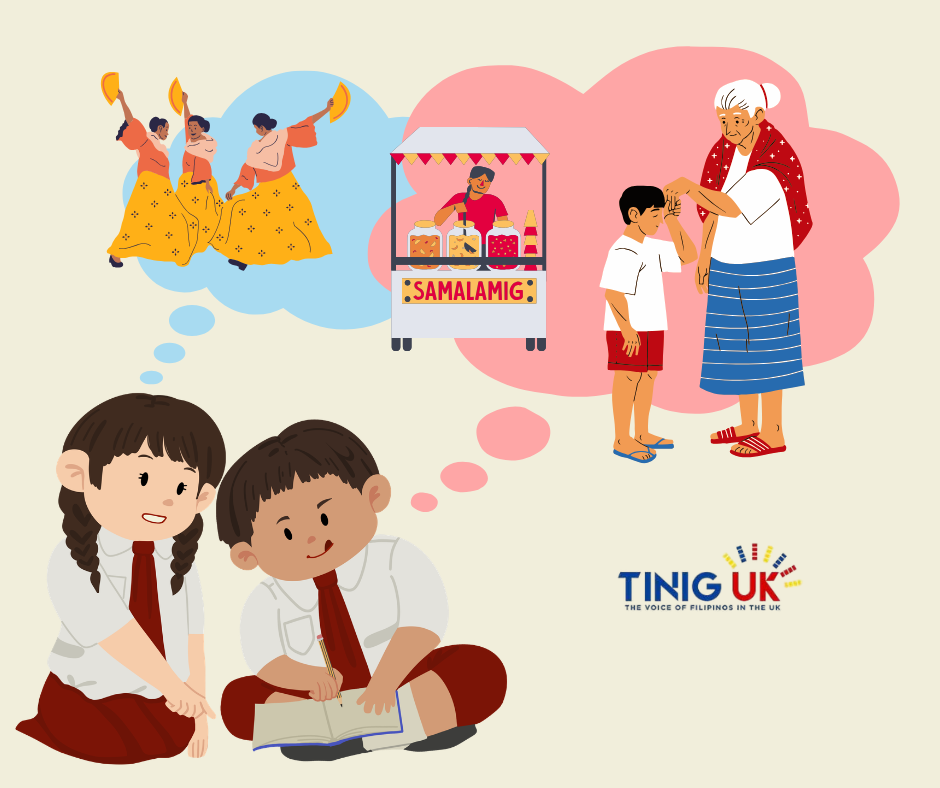
By Elena Baldwin
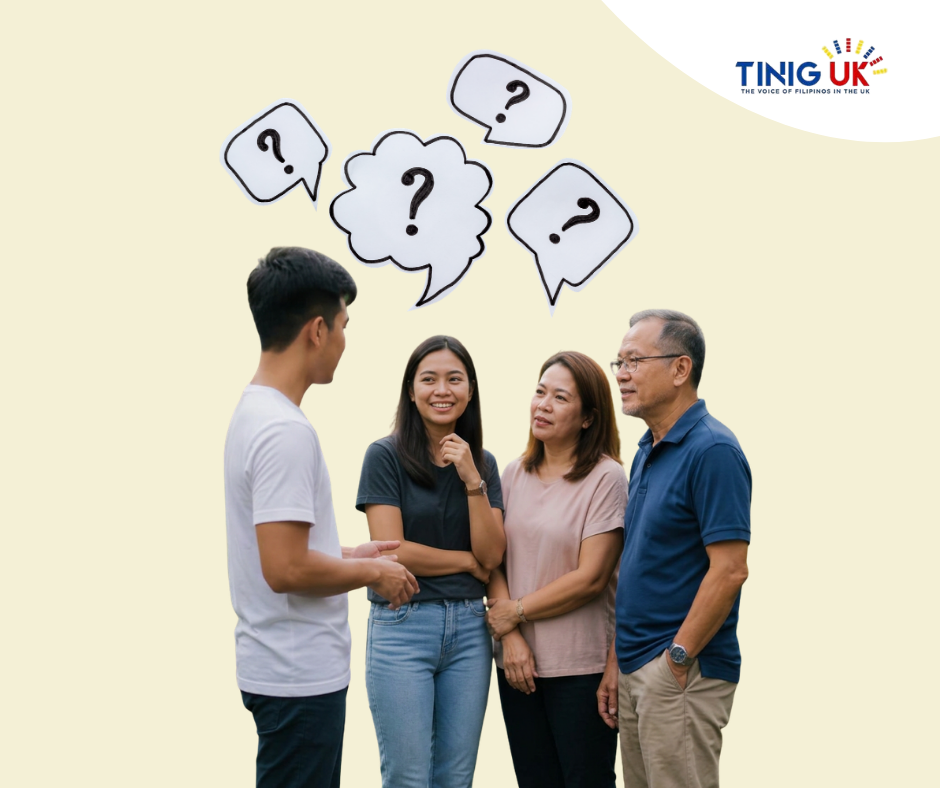
Recently, I read a Tinig UK article asking, “Am I Filipino enough?” It stayed with me, probably because I wasn’t reading it only as a Filipino. I was reading it as a mum raising Filipino British children here in the UK.
And my first thought was: Ay, will my children ask themselves this one day?
It’s not because I think they need to prove how Filipino they are. They don’t. But it made me wonder what their Filipino identity will actually feel like to them when they’re older — and how much of that starts with us, their parents.
Realistically, Britain doesn’t need much help introducing itself to my children. They live here. They go to school here. Their friends are here. English is everywhere. The Filipino side? That’s different. That has to travel through us somehow.
Do we actually think about passing it on? I don’t think most Filipino parents wake up thinking, “Right. Today I must preserve Filipino culture.”
Life is busy. And when you’re raising children in Britain, the easiest thing is often to go with the world already around them. We are trying to get everyone dressed, get to work, remember the PE kit, work out dinner and somehow get the children into bed at a reasonable time.
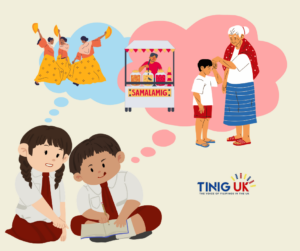
We speak English because it’s easier. Our children answer in English anyway. They eat adobo or sinigang, know who lola (grandmother) is, come along to Filipino parties, and maybe attend a barrio fiesta in the summer. If we’re lucky, we take them back to the Philippines.
So perhaps we think, “Okay na ‘yan (That’s okay). They know they’re Filipino.” But lately I’ve been wondering whether knowing you are Filipino and actually feeling connected to being Filipino are two different things.
Then there is the language question
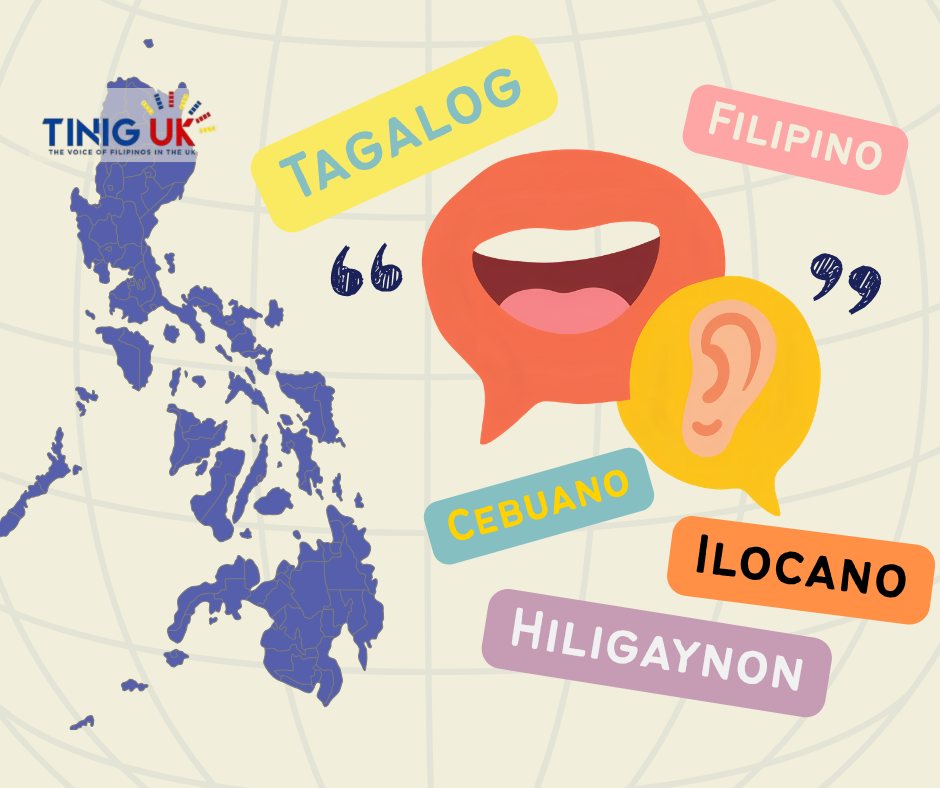
This one can make Filipino parents feel guilty very quickly. Do our children speak Tagalog? Bisaya? Ilocano? Hiligaynon? Or whichever Philippine language belongs to our family?
Mine are growing up in a home where English naturally dominates too, so I’m not writing this from some perfect bilingual household. Far from it. Sometimes you start speaking in Filipino and they answer in English. Sometimes English is simply quicker. And sometimes, after a long day, you just want everybody to understand each other without turning dinner into a language lesson. Gets ko (I get it).
But language carries more than instructions. It carries jokes. Lambing (affection). The little expressions our parents use. The way a lola tells a story. Even the way someone says, naku (oh no) can tell you an entire paragraph without actually saying one.
That is the bit I worry about losing — not whether my children can pass a Filipino vocabulary test, but whether they’ll understand those little pieces of family life that don’t translate perfectly.
But do all Filipino parents even worry about this? Maybe not. And I think that’s worth saying. Some parents may genuinely feel that their children are growing up British, and that’s simply their life. Others may care deeply about Filipino culture but don’t have the time, confidence or family network nearby to keep it present every day.
For earlier generations of Filipino migrants, there was another reality. Many were busy establishing themselves here, working, sending money home, raising children and trying to make a life in a country that wasn’t originally theirs. Maybe fitting in mattered more than standing out. Maybe survival came before cultural preservation.
So this isn’t about blaming our parents. And please, this isn’t another thing for Filipino mums and dads to feel guilty about. We have enough of those already. The question I’m asking myself is much simpler: Am I choosing what I want to pass on or am I just hoping my children somehow pick it up along the way?
What about the spaces we create for our children?
I’ve been thinking about this at Filipino community events too. We’ve been to a number of barrio fiestas here in the UK, and I genuinely love seeing our community come together. There’s Filipino food, music, performers, traditional costumes, dancing and, of course, the excitement when an artista (celebrity) comes on stage.
For adults, so much of it feels familiar. We recognise the songs. We understand the food. We know what some of the costumes and traditions represent. Sometimes just being surrounded by other Filipinos gives you that little feeling of home.
But lately I’ve found myself watching the children and I keep wondering: what are they actually taking away from the day? There are usually things for children to enjoy, of course. I’m not saying there aren’t. But I don’t often see as many opportunities for them to actively explore the culture behind everything they’re seeing.
Could they learn one of the games we played growing up? Hear a Filipino folktale? Try a few words from different Philippine languages? Discover why a particular tradition matters? Ask their grandparents what childhood was like for them? Make something, play something, taste something – and understand the story behind it?
Seeing culture and connecting with culture aren’t necessarily the same thing. A child can watch a traditional dance without really knowing what they’re watching. They can see a beautiful Filipiniana or Barong Tagalog (traditional and national attire of the Philippines) without knowing its story. They can spend an afternoon at a Filipino fiesta surrounded by Filipino culture, while much of the meaning still belongs to the adults around them.
And I don’t say that as a criticism of the people organising these events. Putting on a community fiesta is already a huge amount of work. If anything, I see it as an opportunity for all of us.
What if our fiestas weren’t only places where our children could see Filipino culture, but places where they could explore it, play with it and make it their own? I’m definitely not suggesting turning a fun family day into a history lesson. Naku, the children would run away.
I mean something much simpler: games to play, stories to hear, things to touch and make, little challenges, conversations with older generations. Something they can go home talking about because they were part of it, not just watching it.
If we want the next generation to stay connected, perhaps we can’t only invite them to our celebrations. We need to give them a part in them.
What happens when it reaches the next generation?
I was born and raised in the Philippines. Certain things are just there in me. Food, family habits, humour, the way relatives interact, the memories behind certain words. I don’t have to consciously learn them.My children are different. Their relationship with the Philippines will already be one step removed from mine.
And one day, if they have children of their own, what will they pass on? I don’t know. Maybe they’ll become more interested as teenagers. Maybe they’ll go looking for that Filipino part of themselves as adults. Maybe they’ll surprise me and hold onto far more than I expect.
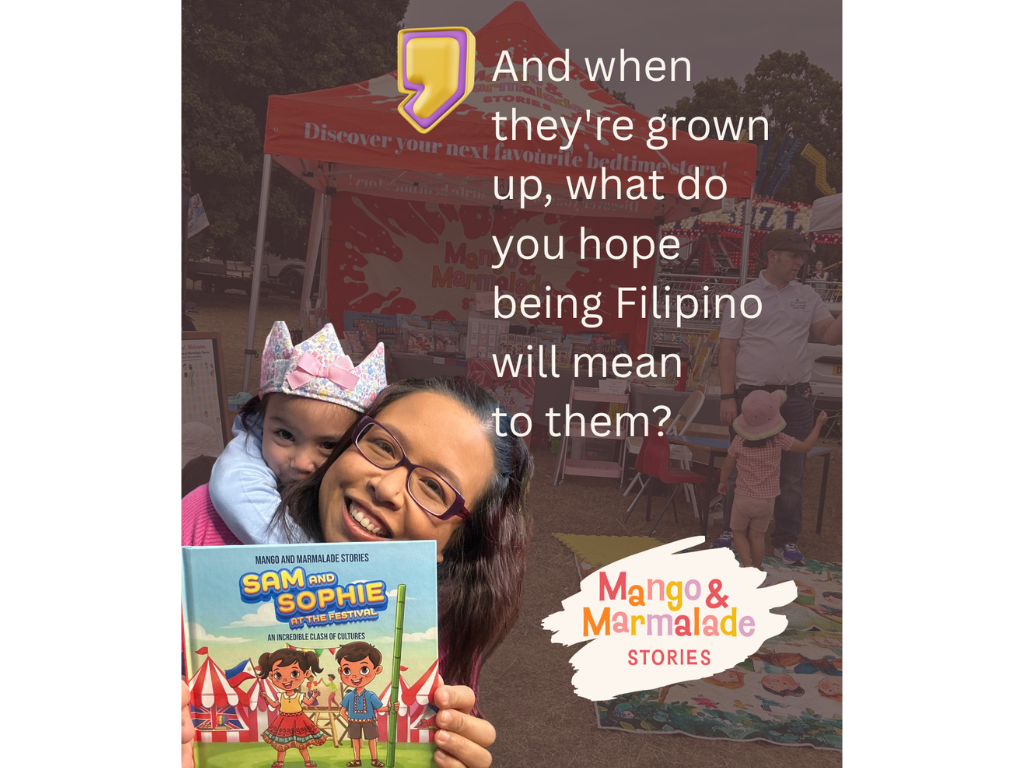
But I would like to give them something to start with. For me, stories became one small way of doing that. This is partly why I ended up creating Mango & Marmalade Stories, not because I think a children’s book can solve the whole identity question. It can’t. And I don’t want every Filipino moment in my children’s lives to feel like a lesson in heritage. I just wanted Filipino British family life to feel ordinary on the page.
Sam and Sophie can have mum, dad and lola. Filipino food can appear because that’s what the family is eating. Culture can sit alongside rainy afternoons, games, family jokes and the usual chaos of childhood. Because maybe that’s how we pass culture on best, not always with a big “Today we are learning about the Philippines!” moment, but through hundreds of small ones.
Cook something your mum used to make. Call lola. Teach them a game you played as a child. Tell them why everyone laughs when Tito tells that same story again. Play the songs you remember. Take them to a Filipino event. Let them ask questions. Hindi kailangang (It doesn’t have to be) perfect. Maybe it just needs to be present.
Perhaps the question belongs to our children too. I don’t want my children growing up feeling they need to prove that they are Filipino enough. Nobody gets to measure that for them. But I do want them to have enough of a connection that, when they are older, they can decide for themselves what being Filipino means in their own lives.
Perhaps that’s the part we parents – and our wider community – can influence now. Not by recreating our childhood exactly. We can’t. Their childhood is theirs. But by giving them enough stories, relationships, language, food, memories and ordinary family moments to build from. So I’d love to ask other Filipino parents raising children in Britain:
Do you actively try to pass Filipino culture on to your children? Do they speak a Philippine language? When you take them to Filipino community events, what actually helps them connect? Is staying connected something you worry about – or, honestly, not really? And when they’re grown up, what do you hope being Filipino will mean to them?
About the author
Elena Baldwin
Elena Baldwin is a Filipino-British mum of two and the founder of Mango & Marmalade Stories, an independent children's publishing brand inspired by family life, culture and the everyday moments children remember. Her Sam and Sophie stories follow Filipino-British twins growing up with influences from both sides of their family.