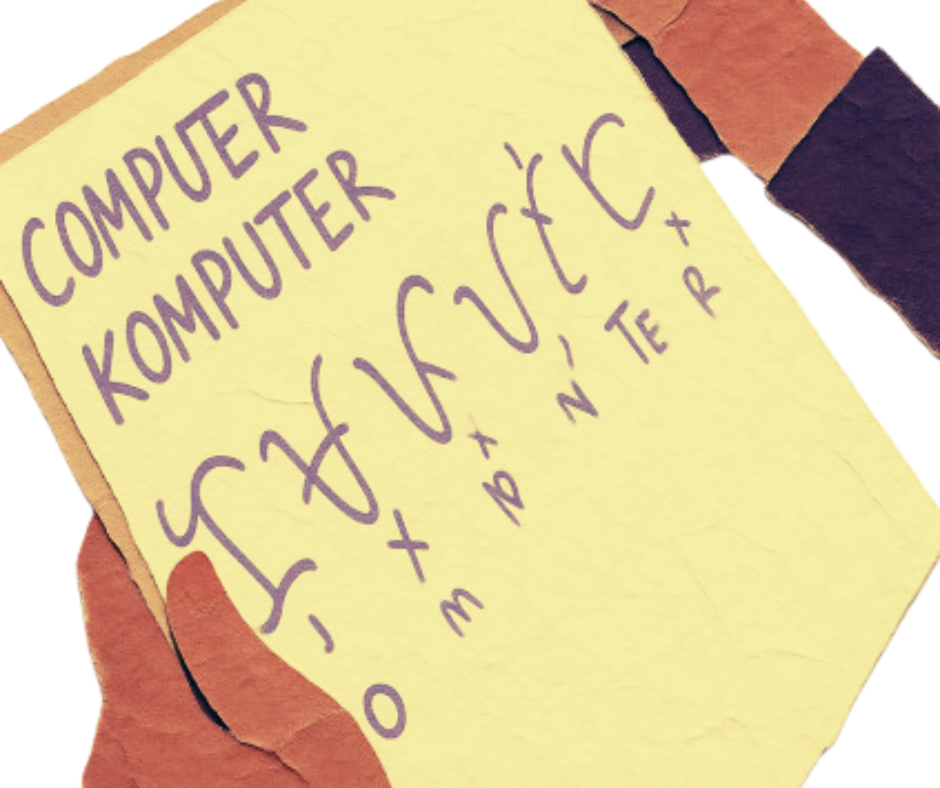
Baybayin, one of the Philippines’s pre-colonial writing systems, was no longer just an aesthetic slapped onto the page of a bubble tea drink or an artisan shop – it transformed into a living practice of art, history and community.
By Juliana Pamiloza
When I entered Battersea Power Station, where CelebrASIA 2026 took place on 11-13 September, London’s largest Southeast Asian festival, I was hopeful as a first-generation immigrant to rediscover and replant my roots.
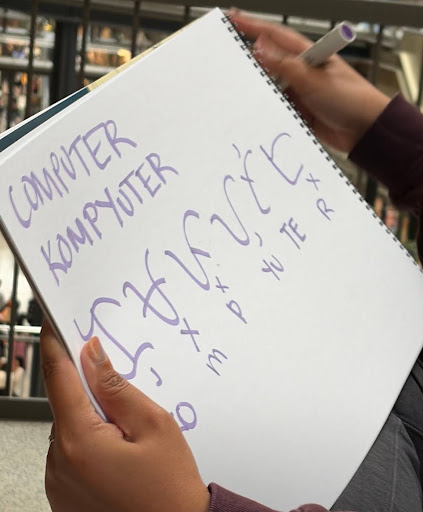
I joined the Baybayin workshop, organised by the London Filipino Centre and led by Trini Tait, a Filipina multimedia designer who currently works as Junior Creative Lead at Social Fitness. While we introduced ourselves, I recognised a common thread tying us together: we all wanted to learn this ancient indigenous script to strengthen our connection to the motherland. We were all inspired by Tait’s love of Baybayin, eager to get stuck into the task at hand: writing out vowels, consonants and, eventually, our own names.
The history of Baybayin
Thanks to Tait’s explanation, we learnt about the intricate origins of Baybayin. Before Ferdinand Magellan’s arrival in the Philippines in 1521, Filipinos already had advanced writing systems. The Laguna Copperplate Inscription, c.900 CE, is the earliest known calendar-dated written document in Old Tagalog and the Kawi script, presumed to be Baybayin’s predecessor. Writing was crucial for trade, law and commemorating the dead. For instance, the Calatagan Pot, a burial jar from the 14th century, had Baybayin engraved around its neck.
During the Spanish colonial era, Baybayin remained present. It was deployed amongst Latin Tagalog and Spanish in the 1593 Doctrina Christiana (Christian Doctrine), believed to be one of the earliest printed books in the Philippines. The 1613 Vocabulario de la Lengua Tagala (Vocabulary of the Tagalog Language) made explicit reference to the script by recording Tagalog words in Baybayin.
The rules of Baybayin
In Baybayin, there are seventeen characters, three of which are vowel sounds – A, EI, OU – and fourteen of which are consonants. These characters represent pairs of a consonant and a vowel sound (an abugida).The vowel sound becomes modified by small diacritics called kudlit – placed above the character for the EI sound, and below the character for OU sound. A cross-mark (krus kudlit or virama) cancels the vowel entirely.
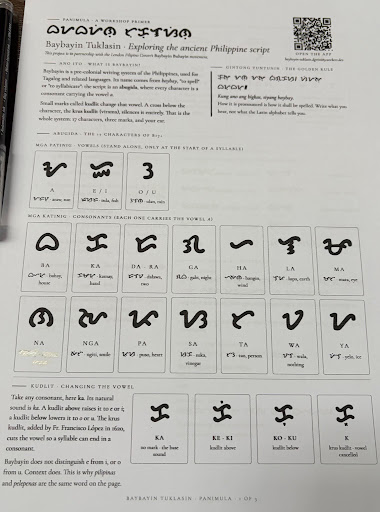
The golden rule of Baybayin is that words aren’t written as they would be spelled, but how they would be pronounced. We learnt how to sound out words according to the Old Tagalog alphabet called Abakada, which only has twenty letters. The modern Filipino alphabet has twenty-eight letters. Then, we matched these sounds to a certain character in Baybayin. As explained by Tait’s handout: Kung ano ang bigkas, siyang baybay. (How it is pronounced is how it shall be spelled.)
For instance, Juliana, my name in English, would be pronounced Hu-l-ya-na in Baybayin. The old Tagalog alphabet did not have a letter J, so it is represented by H, reflecting the Spanish pronunciation of J. My name would then be written according to this pronunciation with kudlits to change the vowel sounds: ᜑᜓᜎ᜔ᜌᜈ
Connecting with the past in the present
We practiced writing each character out at first. We repeated a character if we made a mistake, or if we wanted to refine its curve or the clarity of the kudlit. While it was a daunting task for me at first, I slowly eased up, allowing myself to let go of any inhibitions and envisage the activity as a way of healing. With each character I inscribed onto the page, the ink became increasingly bolder and the pen was manipulated with more confidence.
I felt closer to my heritage than I had at any barrio fiesta or seeing a Filipino represented on international television – not because I didn’t care for these events, but because I better understood the Philippines’ indigenous practices and, as simple as this may sound, its existence in Filipino culture.
Baybayin was no longer an aesthetic slapped onto the page of a bubble tea drink or an artisan shop. It transformed into a living practice of art, history and community, which was crystal clear with the participants in the workshop: a trailblazing creative, a father searching for his roots and his son discovering them. It was heart-warming to see them thrive in the craft, absorbing Baybayin’s complex rules and diving immediately into the practice. This observation affirmed to me that the preservation of Filipino culture can only occur through reflecting on our past and reinstating this into the future.
What’s in a name?
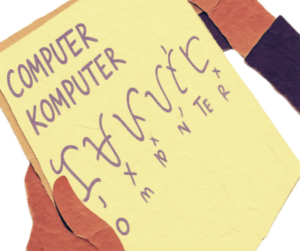
I worked quietly as I pondered these questions on belonging and rediscovery, gradually gaining my footing as I wrote down the characters to my name. The initial tries came out rather thick and large in comparison to the neatness of my peers, but it did not matter so much. Tait supported me with each stroke and kudlit, and soon enough I was writing my name down on this gorgeous craft paper – Hu-l-ya-na.
There is so much power in a name, especially one whose identity has tried to twist and conform to colonial standards. The Clavería Decree in 1849 mandated Filipinos to adopt permanent and hereditary surnames. While I may never know the original name of my ancestors before the decree, I am very proud to display the name chosen by my Filipino parents in its pre-colonial form.
Rediscover your roots
I walked out of the workshop only to be greeted by smiley stall vendors and aspirational artisan artists, breathing examples of how East and Southeast Asian heritage lives today. I feel proud to be able to embrace my roots so openly amidst a growing climate of division and the insecurities that come with a multicultural identity. I encourage everyone to be curious and challenge the obstacles that may be hindering them to explore their cultural identity, be it through a workshop or community event.
I also hope to see the resurgence of Baybayin. It already appears on the Filipino passport, one of the main emblems of Filipino identity. In 2014, two land deeds that are handwritten entirely in Baybayin were declared as National Cultural Treasures and are currently kept at the University of Santo Tomas in the Philippines. Perhaps one day Baybayin will coexist with the modern Filipino and English alphabets seamlessly in the Philippines as we see with Cymraeg in Wales, or Gaelic in Ireland.
About the author
Juliana Pamiloza
Juliana Pamiloza is a Filipino British daughter of first-generation immigrants. She is a graduate from St Anne’s College, University of Oxford, where she read her BA in English and Spanish. Her love of writing began from a young age, becoming a published writer for her local Guardian under the Young Reporter Scheme. During her time at Oxford, she developed her passion as a writer and editor for The Oxford Blue and The Oxford Linguist, and wrote articles as an intern for Press Gazette. Her writing is rooted in female empowerment, identity and belonging.