Filipino director Rafael Manuel’s assiduous debut feature spotlights the entrenched class divisions plaguing Asia’s tourism industry, challenging viewers to look closely at a world designed to keep labourer realities out of frame.
By Jacob Delos Santos
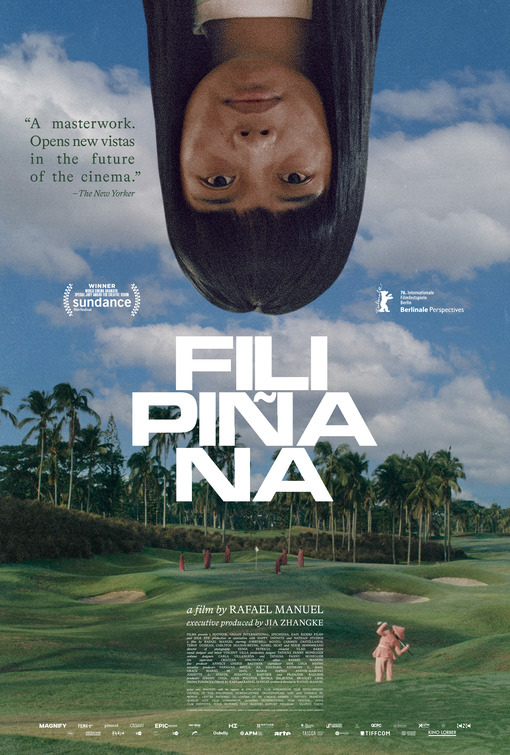
A full-length expansion of the 2020 Silver-Bear winning short film, Filipiñana is an astute visual thesis on the imperious proclivities of post-colonial Philippines, set through the lens of 17-year-old Isabel (Jorrybell Agoto), a young Filipina from rural Ilocos now working as a “tee-girl” for Dr. Palanca’s (Teroy Guzman) lavish Manila golf resort.
The film erupts in the bustling streets of Metro Manila, where a government worker beckons “one water container per family” amongst a frantic queue of Filipinos awaiting rationed water during a seasonal drought.
The cacophony of raucous residents and blaring jeepneys strikes a claustrophobic unease before it is immediately discarded, cutting straight into an arcadian shot of the perfectly manicured lawns of the country club, sprinklers freely saturating swathes of well-kempt emerald grass.
Director and writer Rafael Manuel establishes his distinctive filmmaking voice from the onset, refusing to facilitate conventional narrative momentum through explicit dialogue, instead choosing meticulous thematic experimentations through piercing imagery. Everything at the golf resort is jarringly immaculate – unblemished grounds, lavish banquets and pampering staff boast a level of luxurious convenience that sways almost saccharine.
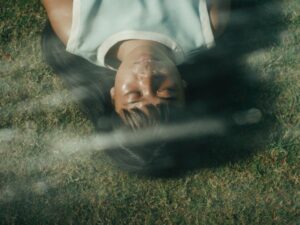
This visual strategy is central to Filipiñana. Cinematographer Xenia Patricia’s fastidious mise en scene, dollhouse framing and pastel-hued compositions invite strong comparisons to Wes Anderson, with each scene instilling a foreboding sense of artificialness. Whereas Anderson might deploy such methods for deadpan whimsy, Manuel combines hollow visuals with surrealist, bourgeois satire à la Luis Buñuel.
By glorifying such visual perfection against the sunken backdrop of upper-class vapidity, the golf club feels uncanny and erringly choreographed, as if one big sinister musical.
Manuel hints at further ominous clues but never addresses them directly – someone is said to have recently died from the heat, a shot of security patrols escorts a worker away from the grounds, a group of elite women in Maria Clara’s fan themselves against the scorching sun. Yet, the violence of structural, gender and class inequality never explodes into the frame. Instead, forbidden topics are left hanging in the air, just like the debilitating humidity disproportionately affecting the workers, versus the rich who can afford to “leave [their] aircon on all day”.
The result is a narrative whose formal beauty is inseparable from its story-telling provocation, acutely evoking Edward Said’s theory of Orientalism, which argues that the exotification and wanderlust of the Global South (the “Orient”) justifies its imperialist subjugation from more sinister powers.
Manuel refuses to explicate the US’s relinquishment of the Philippines in 1946 as the colonial vestiges are already so clearly present throughout the environment itself. The sheer serenity of the golf club makes it far too easy to forget that something ever lived there in the first place, and that beyond the perfectly mowed grass and manufactured sandpits, the Philippine’s facilitation of the western import subliminally functions as a small-scale reenactment of the obliviating impacts of gentrification.
Such themes are further iterated through Clara (Carmen Castellanos), a wealthy, educated Filipino American balikbayan (a returning Filipino) whose mestiza features, light-skinned complexion and exclusive dialogue in the English language foment social hierarchy over the Tagalog, Ilocano, and Mandarin speakers amongst the grounds, regardless of Clara’s earnest refusal to conform to the country club’s exploitative culture.
Manuel’s distinctive approach is not one without challenge though. The pacing of the film mimics that of an actual golfing match – long extended zoom-in shots, deliberately slow contemplations and ham-fisted music scenes – demands patience and formal discipline from viewers, which may occasionally distract from the overall richness of the film’s social critiques.
Agoto’s performance as Isabel is remarkably restrained. As Filipiñana’s supposed protagonist, Isabel does not actually have many spoken lines at all, instead communicating through naive eye movements and lackadaisical body language which can heavily protract already sparse dialogue. However, her furtive interactions with the luxuries engulfing her, such as freshly laundered towels, unspotted mangoes and decadent glass-domed cakes, still offer compelling moments in her overall character development, as well as furthering the foreboding rot festering beneath Dr Palanca’s curated paradise.
“If one of them dies, it will be replaced”, a gardener dismissively remarks during the beginning about a wilting snag blighting the grounds’ manicured sheen. Yet only until the final frame does the phlegmatic statement reveal its truly unsettling weight – the abrupt disposability of crucial set pieces ornamenting the bourgeois residence is in fact synonymous with the proletariat required in pruning it.
The ending is neither comforting nor particularly loquacious. The final scene simply happens, such that the grand culmination evaporates muffledly behind an unceremonious stream of blithely scrolling credits. Textbook grammar of Western cinematic tropes, which typically champions feminine autonomy and the eventual prosperity of its leading female characters, is intentionally exchanged for a matter-of-fact, sterile depiction of women’s societal erasure.
What Manuel achieves is a sharp, reticent indictment of his homeland, echoing centuries of colonial trauma through a meticulously crafted golfing microcosm. Despite their incessant struggles, both Isabel and Clara must ultimately come to determine whose lives are most important, as well as which end of this asymmetrical spectrum, determined entirely by capital, they inherently stand.
Filipiñana abandons the audience with an uncomfortable but universal truth – that the most tragic reflection of society is not hidden beneath some obfuscated surface, but one that the world had already agreed not to see at all.
Filipiñana’s UK premiere is set for 17 October, debuting at the 2026 British Film Institute (BFI) London Film Festival. For the UK and Ireland, a full cinematic release is set for 20 November. BFI hosted a private London screening for the press on 24 September.
About the author

Jacob Delos Santos
Jacob Delos Santos is a Filipino sexual health specialist for Brook, UK. A masters graduate in media and communications from SOAS University of London, and a medical physiology alumnus from the University of Leicester, he has lived and studied in the UK since age 4. A former biology researcher, he now works as a RSE facilitator, covering topics such as contraception, STI’s, and intersectional relationships across Camden and Islington. His freelance writing has appeared in Filipino-British and university media outlets. With Tinig UK, he is interested in reporting on political, tech and misinformation stories, both domestically and abroad.