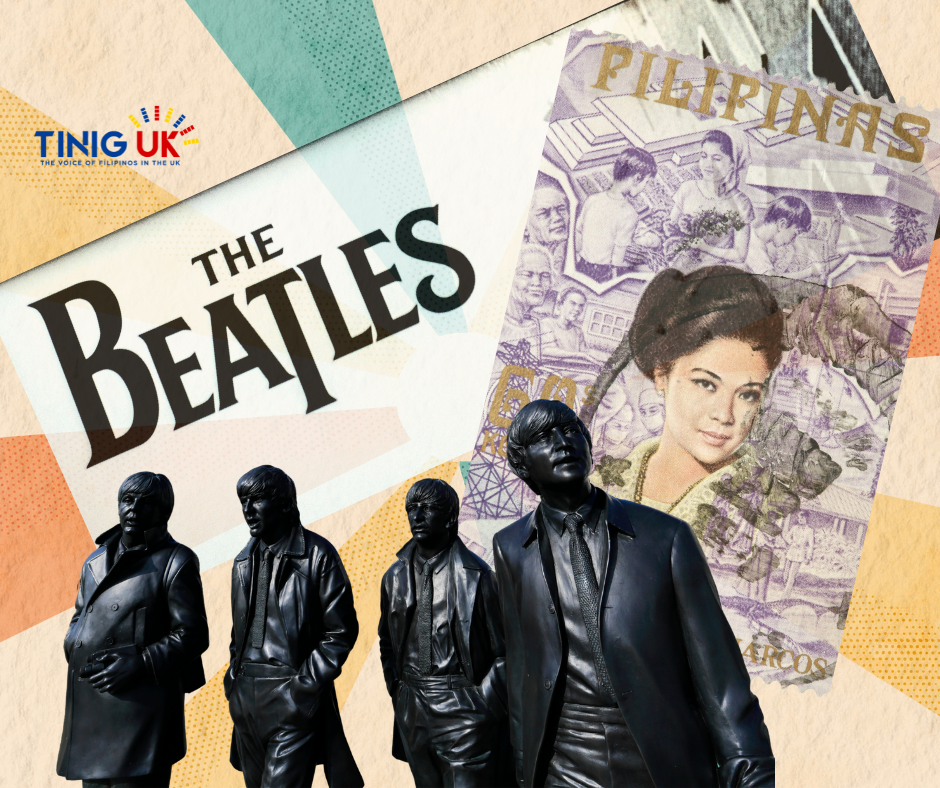
For decades, the story of the Beatles’ disastrous 1966 visit to Manila has been told from the band’s perspective. As Filipino British author David Guerrero prepares to launch his new book in Liverpool, he revisits one of pop culture’s most enduring myths — and asks what happens when history is written by only one side.
By Veronica Pedrosa
When Ringo Starr declared “I hated the Philippines” in The Beatles Anthology, millions may have accepted it as the final word on one of the most notorious episodes in the band’s history.
For decades, the story of the Beatles’ disastrous 1966 visit to Manila has been told largely through the eyes of the world’s most famous band: an invitation to the presidential palace, a perceived snub of First Lady Imelda Marcos, an angry nation and a terrifying escape that helped convince the Beatles to stop touring forever.
But what if that wasn’t the whole story?
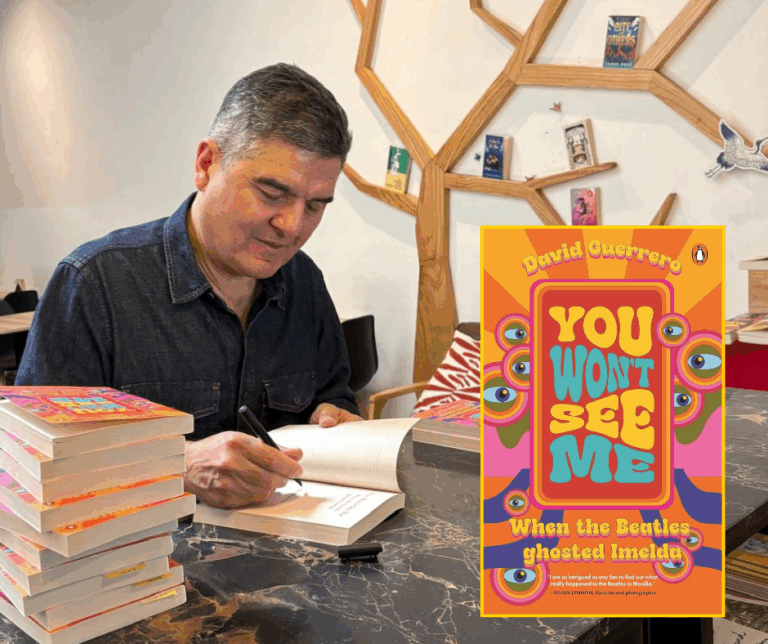
As Manila-based writer David Guerrero prepares to launch You Won’t See Me: When the Beatles Ghosted Imelda in Liverpool this month, he is revisiting one of the most enduring myths of modern pop culture from a perspective rarely heard outside the Philippines.
Drawing on interviews with witnesses, fans and participants largely absent from previous accounts, Guerrero explores how a diplomatic misunderstanding became a global narrative that shaped perceptions of an entire country.
The Liverpool launch is a fitting venue. It is the city that gave the world the Beatles, and the place where one version of the story has long been accepted as fact. Guerrero’s book asks fans and readers alike to look again.
I spoke with Guerrero at the Singapore launch of the book. Our conversation ranged from Beatles fandom and the mythology of Imelda Marcos to larger questions about who gets to tell history — and who gets left out.
A world tour — and a collision of cultures
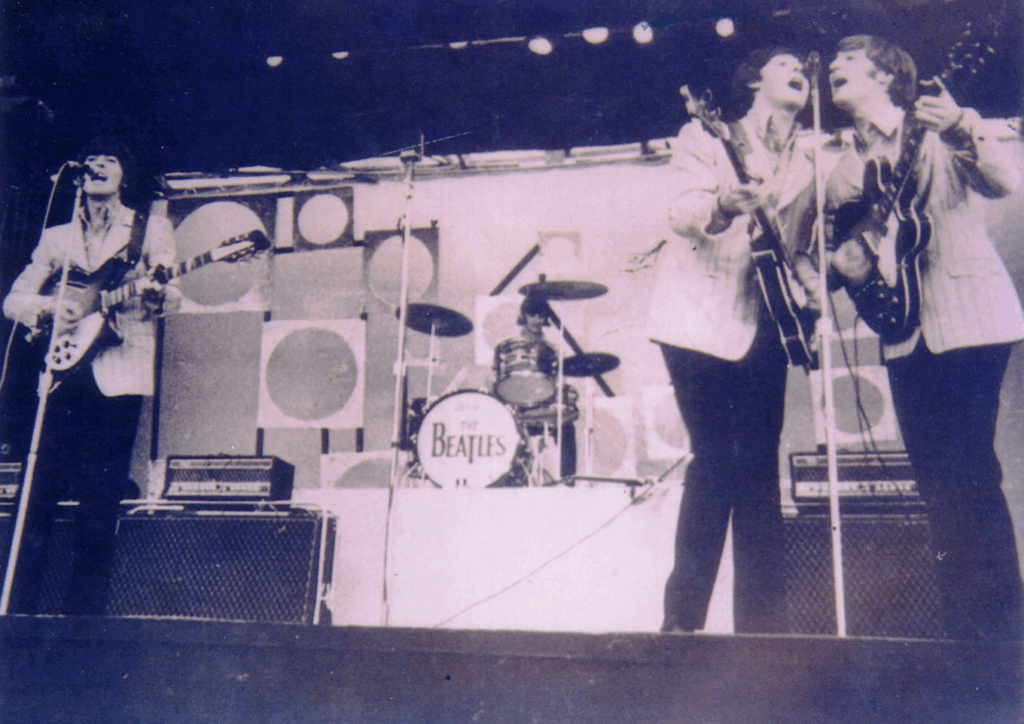
When the Beatles arrived in Manila in July 1966, they were at the absolute height of their fame. They had conquered Britain and the USA. They were selling out stadiums worldwide, and midway through what would become their final tour.
The Philippines, on paper, looked like a triumphant stop.
At the time, much of Asia was closed to Western pop acts. China was in the throes of the Cultural Revolution. Indonesia had banned the Beatles. The Vietnam War was escalating. Singapore was barely a year old.
The Philippines, with its vibrant music culture and deep American influences, was one of the few places in the region where Beatlemania could flourish at full volume.
And flourish it did.
Fans mobbed the band on arrival. Demand for tickets was extraordinary. The concerts drew a combined audience of around 80,000 people in a single day — the largest crowd that the Beatles would ever play to in a single day.
Yet almost from the moment they landed, there were signs that this would not be an ordinary tour stop.
For starters, the Beatles were taken to the Philippine Navy headquarters – an odd venue by any measure for a press conference. They were housed aboard a boat in Manila Bay, ostensibly to shield them from fans. Eventually they abandoned the arrangement and checked into the Manila Hotel in the early hours of the morning.
The next day, events took a decisive turn.
Representatives from Malacañang Palace arrived to escort the Beatles to a luncheon hosted by First Lady Imelda Marcos. The band did not attend.
The snub that became legend
From the Beatles’ perspective, the situation was straightforward. They maintained they had never accepted the invitation and regarded the day as free time.
From the perspective of the presidential palace, it looked very different.
Some 300 guests had been invited. Food had been prepared. Journalists had assembled. Television cameras were ready. Imelda Marcos, then only months into her role as First Lady, had planned a high-profile reception for the world’s most famous band.
The Beatles never arrived.
Exactly where the misunderstanding occurred is still disputed. Guerrero’s research finds contradictory accounts even among people close to the band. Some claimed the invitation had been declined. Others indicated it had not been dealt with properly.
What is clear is that at some point Malacanang Palace felt confident enough that the Beatles would attend that it organised a major public event around their appearance.
What followed was swift and unsettling.
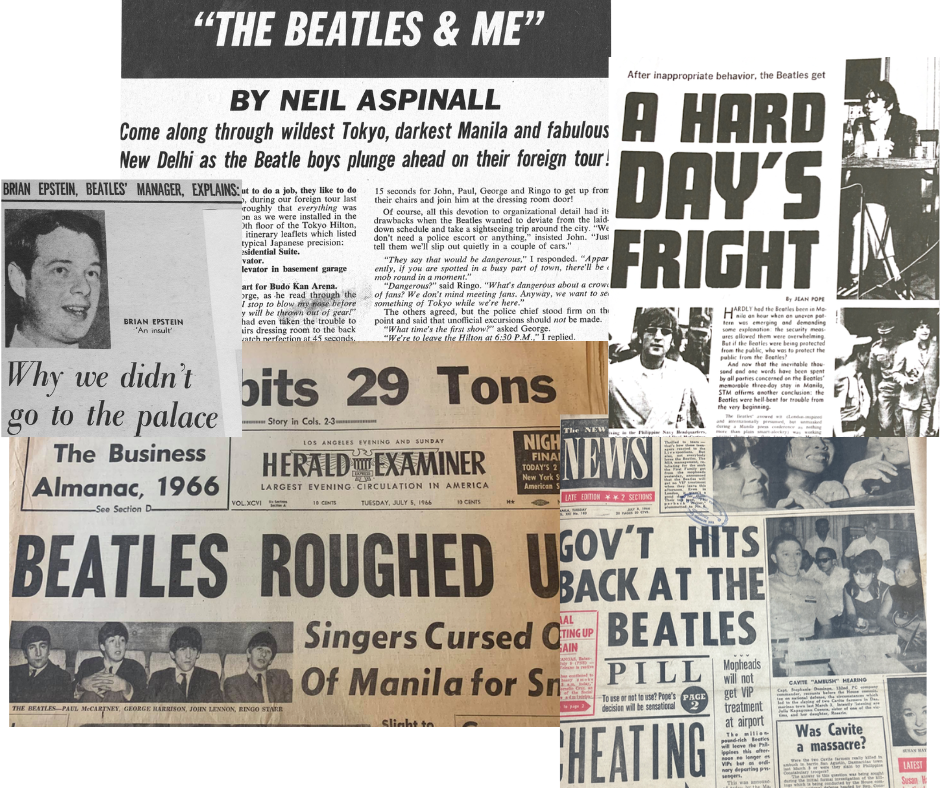
Security protection around the band was withdrawn. A tax demand materialised. Manager Brian Epstein found himself facing official scrutiny.
By the time the Beatles reached Manila airport to leave the country, the atmosphere had become deeply uncomfortable. Escalators were switched off. Palace security personnel watched their movements. Members of the entourage later described feeling intimidated and vulnerable and were physically pushed around.
Nothing catastrophic happened. But the experience left a deep impression.
Soon afterwards, the Beatles resolved never to tour again.
In popular memory, Manila became the place where Beatlemania finally broke down.
Questioning a one-sided history
For Guerrero, who is Filipino British and grew up with connections to both countries, that familiar version of events never entirely rang true.
“When you actually look closely,” he told me, “it wasn’t malice that caused everything to go wrong. It was an excess of trying to make things go right.”
His argument is not that the Beatles invented their experience. Rather, it is that their account became the definitive account because they possessed something nobody else did: a global audience.
The Beatles told the story first. They told it often. And because they were the Beatles, few people thought to question it.
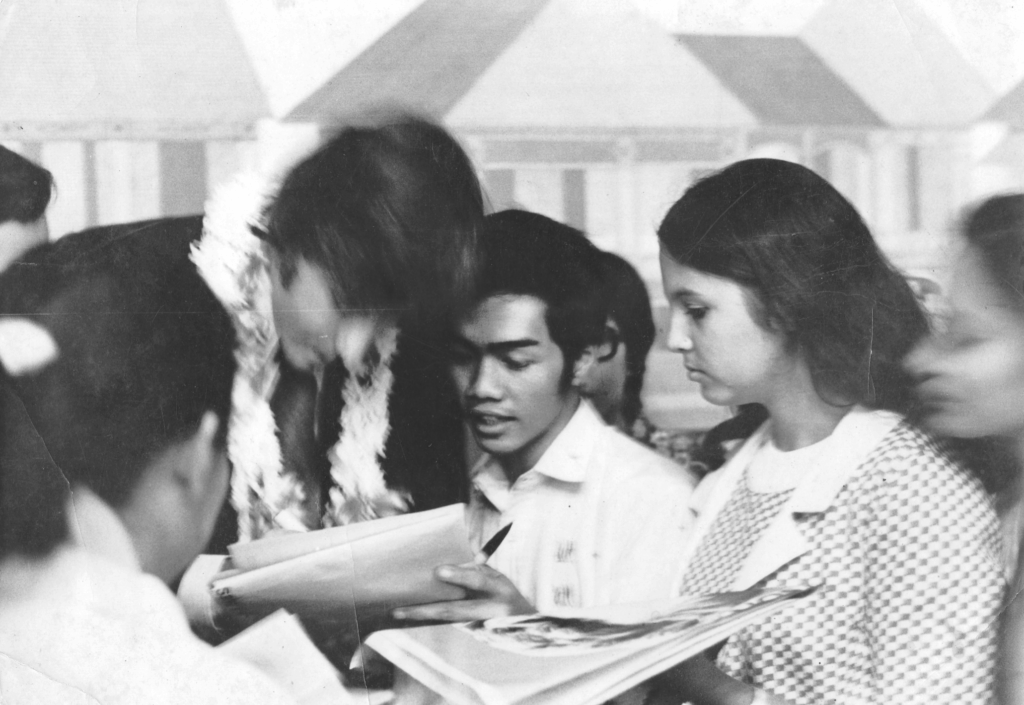
Yet many of the people Guerrero interviewed had never previously been asked for their version of events. Among them were organisers, fans and even the woman who hosted the Beatles aboard the boat in Manila Bay.
Their recollections paint a more complicated picture.
An excerpt of a video interview of Josie Leorado, the head of the Beatles’ fan club in Manila. / Credit: Caloy Soliongco
The Filipino fans, Guerrero notes, cared little about palace protocol. All they cared about was the music. The controversy surrounding the luncheon barely registered compared with the excitement of seeing the Beatles perform.
One striking detail concerns the concerts themselves. The best seats in the stadium were largely empty. They had been reserved for members of the First Family and their guests, many of whom chose not to attend after the palace incident. The result was an unusual spectacle: tens of thousands of ecstatic fans filling the venue while prime seats near the stage sat vacant.
For many Filipinos overseas, particularly those who grew up between cultures, the dynamic feels familiar. The Philippines is often encountered through narratives produced elsewhere — through headlines, stereotypes, political scandals or celebrity anecdotes.
Guerrero’s project is not to overturn the Beatles’ account. It asks what happens when one version of events becomes so dominant that other voices disappear from view.
Asked why the story might matter to younger Filipino British, Guerrero sees it as part of a broader reckoning with identity and confidence.
“Don’t wait for the country to be perfect,” he told me. “It never will be.”
Too often, he argues, Filipinos have been reluctant to assert their own narratives. Influenced by cultural traditions that prioritise the collective over the individual, and by a Catholic heritage that prizes humility and forbearance, many have been hesitant to step forward and challenge received wisdom.
“The Philippines is not noisy on the global stage,” he says. “That needs to change.”
For Guerrero, revisiting episodes like the Beatles’ Manila tour is not about national defensiveness or historical score-settling. It is about engaging honestly with the past — acknowledging mistakes, understanding context and learning from both.
“We can start by addressing our past through the mind of the present,” he says. “Let’s not close our eyes to the past but rather see the lessons from it as a guide to the future.
More than a Beatles story
The book’s title, You Won’t See Me, hints at a broader concern, beyond the reference to the Beatles track.
This is not simply a story about a diplomatic misunderstanding or a celebrity-political clash. It is a story about visibility: who gets to be seen, heard and remembered when history is written.
Guerrero takes care not to reduce the episode to a simple conflict between the Beatles and Imelda Marcos. Instead, he brings ordinary Filipinos back into the frame — the fans who queued for tickets, the families who incorporated Beatles songs into the soundtrack of their lives, and the people whose enthusiasm helped make the Philippines one of the band’s most successful stops.
The book also invites readers to consider larger themes.
There is the shifting balance between celebrity culture and political power. There is the tendency to judge entire countries by the actions of governments or leaders. And there is the enduring question of whose perspectives shape the historical record.
In many ways, the Manila story sits at the intersection of all three.
The Philippines that hosted the Beatles in 1966 was also the Philippines that would later be viewed through the lens of Ferdinand and Imelda Marcos, martial law and corruption. Retrospectively, those later events coloured perceptions of the earlier episode. It became easier to view the Beatles’ experience as a confrontation with a regime that history would later condemn.
But that hindsight can obscure the fact that the vast majority of Filipinos involved had no role in the political drama at all.
They were simply fans.
A story worth retelling
By 1966, the Beatles were already moving beyond life on the road. Revolver had been recorded before the Manila visit, even if it was released afterwards. Their future lay increasingly in the recording studio rather than in stadiums filled with screaming audiences.
Yet the Philippines became fixed in popular imagination as the place where the dream soured.
Nearly sixty years later, Guerrero’s book offers neither vindication nor condemnation. Instead, it argues for something rarer: complexity. Misunderstandings. Contradictory memories. Human frailty on all sides.
As someone who has spent much of my life moving between Britain and the Philippines, I was struck by Guerrero’s choice to focus less on the question of whether the Beatles or Imelda Marcos were “right” and more on who was missing from the argument altogether.
The fans who packed the stadiums. The organisers who tried to make the visit work. The ordinary Filipinos whose affection for the Beatles far outlasted the controversy.
For Filipino British especially, Guerrero’s book is a reminder that pride in our heritage need not depend on perfection. Nations, like people, are complicated. The challenge is not to ignore their flaws but to understand them honestly and place them in context.
The most revealing aspect of this story may not be the clash between a global band and an ambitious First Lady. It may be what happens when an entire country becomes known through a single anecdote — and what can be recovered when we finally listen to the people who were there.
Guerrero’s achievement is not that he rewrites history. It is that he widens the frame.
Register to join David Guerrero at Waterstones Liverpool on Monday, 29th June, for the launch of You Won’t See Me: When the Beatles Ghosted Imelda. Hosted in conversation with Howard Johnson, the event features an audience Q&A and a book signing. The book is available to order now through major booksellers and online retailers.
About the Author
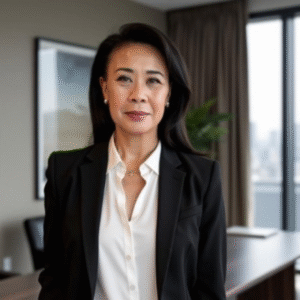
Veronica Pedrosa
Veronica Pedrosa is an award-winning international journalist with more than 20 years of frontline experience. She has reported, anchored and produced for the world’s leading broadcasters, including Al Jazeera English, CNN International and BBC World News.
Her career also spans humanitarian advocacy and strategic communications, with extensive field experience, giving her deep insight into crisis communications, strategic messaging and the ethics of storytelling in emergency contexts.