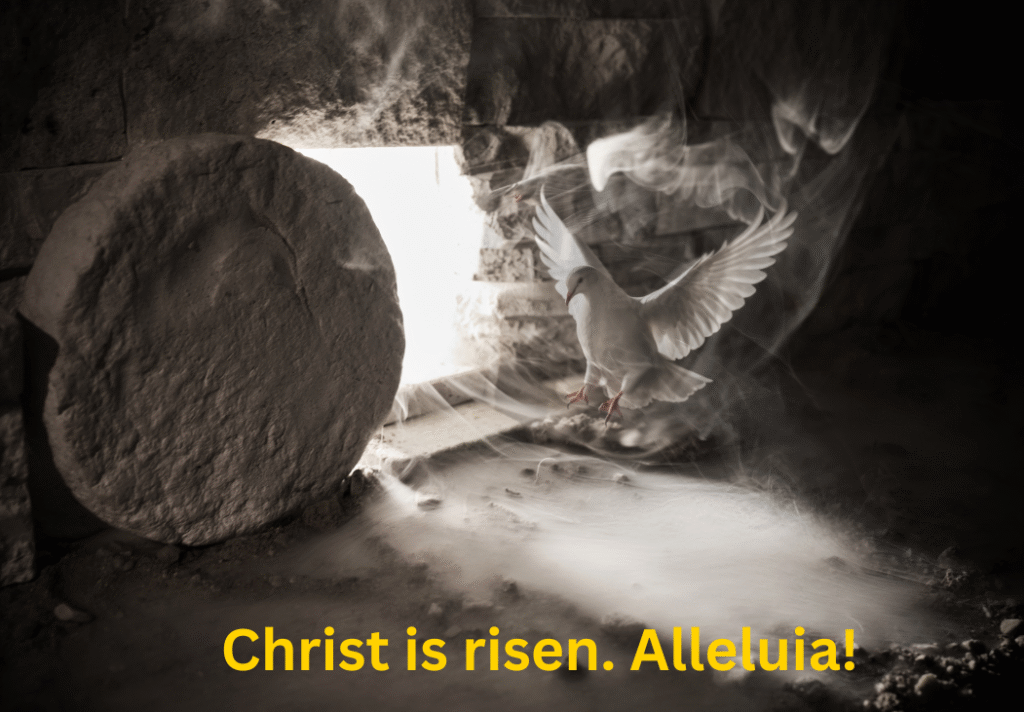
John’s account of the Resurrection begins not with dazzling light but with a quiet, almost fragile moment: “Early on the first day of the week, while it was still dark…” Mary Magdalene approaches the tomb carrying the weight of grief, confusion, and love. The darkness is more than a backdrop. It is the emotional and spiritual landscape of the disciples after the crucifixion. Their world has collapsed. Their hope has been buried. Their understanding of God has been shaken.
And yet, Easter begins precisely there — in the dark.
God does not wait for daylight to act. Christ rises not when the disciples are ready, faithful, or understanding, but when they are lost, afraid, and heartbroken. The Resurrection is God’s initiative, God’s gift, God’s refusal to let death or despair have the final word.
Mary’s first reaction to the empty tomb is not joy but fear: “They have taken the Lord.” The first interpretation of Easter is a misunderstanding. This is deeply comforting. It reminds us that faith often begins in confusion, not clarity. God’s greatest work can feel, at first, like absence.
Peter and the beloved disciple run to the tomb. Peter sees the linen cloths. The beloved disciple sees the same evidence, but something stirs within him: “He saw and believed.” What did he believe? John tells us they did not yet understand the Scriptures. His belief is not a fully formed theology of Resurrection. It is a spark — a recognition that God is doing something new, something beyond their imagining.
Faith often begins this way: not with answers, but with the courage to trust that God is at work even when we cannot yet see how.
The empty tomb is not a spectacle. It is a sign. A quiet, stubborn declaration that death has been defeated from the inside. The Resurrection is not simply the reversal of Good Friday; it is the transformation of it. Jesus does not rise to erase His wounds but to redeem them. He does not rise to condemn His disciples for abandoning Him but to return to them in mercy.
Easter is God’s definitive “yes” to humanity, spoken after humanity has given God its worst.
For us today, this passage speaks into the many forms of darkness we carry — grief that lingers, faith that feels thin, relationships that ache, fears about the world, disappointments in ourselves. The Risen Christ meets each person in John 20 exactly where they are: Mary in her tears, Peter in his failure, the beloved disciple in his searching heart.
To live as Easter people is to let the dawn of Resurrection slowly, gently, persistently break into our lives. It is to trust that no tomb — no sorrow, no sin, no fear — is sealed to God. It is to believe that hope is not naïve but rooted in the God who brings life out of death.
Easter invites us to see the world not as a closed tomb but as a place where God is still creating, still surprising, still raising what we thought was lost.
Christ is risen — and nothing is the same. Alleluia!

 Fr Jimmy Lindero is a Mill Hill Missionary from Iloilo, Philippines, and was ordained a missionary priest in April 2007. He served for eight years in Pakistan and became the first Asian to be elected to the General Council of the Mill Hill Missionaries, serving from 2015 to 2022. The Mill Hill Missionaries is the only missionary society founded in England, and he currently serves as its General Secretary.