By Dianna Bautista
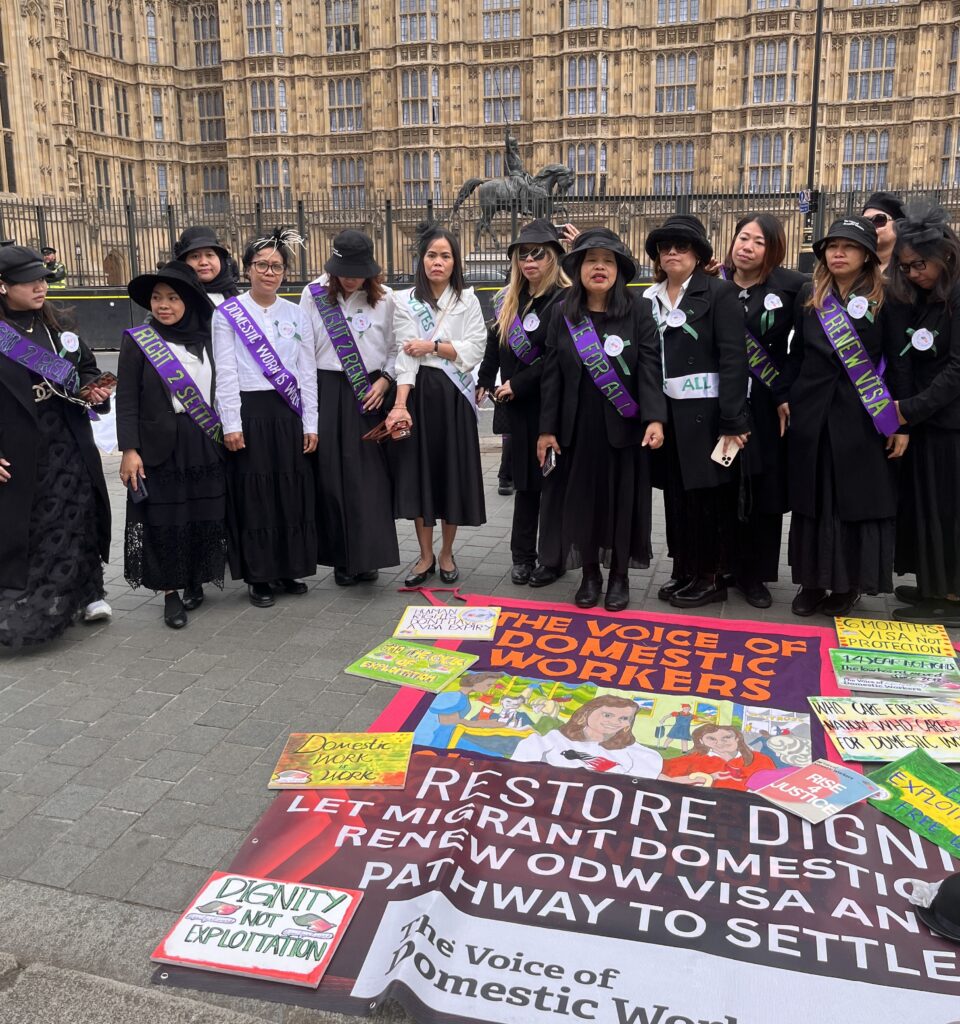
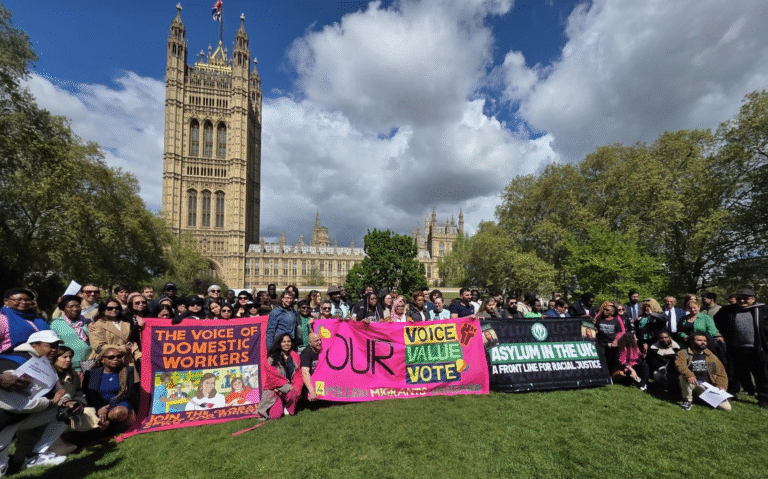
Dressed in long, black dresses like the suffragettes calling for their right to vote in 1910, migrant domestic workers held a demonstration outside Westminster on Monday, 20th April, calling attention to the “invisible” exploitation and injustices happening among them.
Members of the Voice of Domestic Workers (VODW) and their networks were marking 14 years since changes were made to the Overseas Domestic Workers (ODW) visa, the legal route for migrant domestic workers to work in the UK.
“For 14 years, migrant domestic workers (MDWs) in the UK have lived with fear, uncertainty, and injustice since rights were removed on the overseas Domestic Workers Visa on 6th of April 2012,” said Marissa Begonia, executive director of VODW.
Domestic workers’ exploitation happens behind closed doors, Begonia explained in an interview. They are denied food, salary, and some are even raped, she said.
“A public suffragette-style demonstration forces the country to see what is usually invisible,” Begonia continues.
Filipino domestic workers in the UK
A significant number of Filipinos living in the UK are domestic workers brought in legally by wealthy Middle Eastern employers. Home Office data from 2022 reveals that over half of the 18,553 ODW visas issued went to Filipinos.
According to Begonia, Filipino domestic workers move abroad, not for relaxation, but to survive. Similar to a large portion of VODW members, Begonia was herself a migrant Filipina domestic worker before moving into migrant worker organising.
She explains that Filipino migrants are escaping “civil poverty” — exclusion from civic rights, political participation and legal protections, apart from unemployment, in the Philippines. They are unable to provide for their families, especially during illness, and lack access to proper housing.
Calls to allow domestic workers to renew their visas
The ODW visa was originally introduced in 1998 giving MDWs concessions, including the right to change employers and to permanently settle in the UK. However in 2012, the UK government withdrew these concessions, making the visa non-renewable and binding workers to their employers.
Charities such as Kalayaan, FLEX, Unite the Union, Migrant Organise, the TUC, and many others in the Migrant Democracy Project joined the VODW in calling for the visa to be renewable. This would give workers the ability to rebuild their lives after experiencing abusive situations. Additionally, they are asking for a guaranteed route to settlement for domestic workers who have lived and worked in the UK for years. They are also demanding for access to workers’ rights such as holiday pay, written contracts and protection from unfair dismissal.
In one of its reports, Kalayaan found that changes on visa conditions have increased MDWs’ exploitation because they lack options for leaving abusive situations. Their data shows increased incidents of physical and psychological abuse following the 2012 changes, with psychological abuse rising from 44% to 64% for workers whose visa was issued after April 2012.
Although some of these restrictions were addressed in further ODW visa changes in 2016, such as more control over changing employers, for VODW it still isn’t enough.
Begonia is also calling for the Philippine government to take action when they come to the UK, by bringing up the abuses faced by Filipino domestic workers with British officials.
“We allow other workers to be able to work. We want the presence of domestic workers to be visible and recognised by giving back what the workers deserve, which is allowing them to renew their visa, until they settle in the UK,” states Begonia.
Demanding a seat at the table
VODW supports some 16,000 migrant nannies, cleaners, and other helpers who come to the UK, a majority of whom are Filipino. Their work includes caring for young children and the elderly.
However, Begonia acknowledges that the current political climate in the UK adds both a degree of difficulty and necessity.
“Recent tightening of immigration policy has made the VODW’s core goals more urgent, more difficult, and more essential,” she explains.
The increased visa restrictions has heightened women’s vulnerability. They could, as Begonia explains, be less likely to leave an abusive situation due to their concern of becoming undocumented. Further, they face greater barriers to reporting said abuse, becoming increasingly isolated and dependent on their employers. This would put more pressure on frontline support systems such as the VODW.
The Home Office is currently reviewing the Overseas Domestic Worker Visa and has acknowledged MDWs as being a “distinctly vulnerable cohort.”
Given their lived experience, Begonia says the VODW is demanding to be consulted on this review. They have already contacted 50 MPs.
About the author

Dianna Bautista
Dianna is a Filipina-American NCTJ Gold Standard Multimedia Journalist curently in London. A graduate of Jacobs University Bremen in Germany, and the University of Edinburgh in Scotland, she has lived in Germany and the UK since age 17. A former scientist and science communicator, she now works as a journalist, covering science, culture, and misinformation. Her writing has appeared in European and British media outlets. With Tinig UK, she is interested in reporting on Filipino migration stories in the UK.